Decision To Change - After filming a second time using a floodlight, to improve the quality and lighting of the footage, we uploaded the tape on to the computers. We found that the flood lights had made a vast improvement on the quality of footage and you were able to see characters and objects clearer, instead of the dark "grainy" footage we had before. The group then began to edit the clips and put the story together.
As this time we edited was after I had carried out deep analysis on many film opening sequences and whole films I felt that we had got the wrong impression and had been swayed off task. When we told to make a "Thriller Opening" we immediately tried to fit the the whole plot and storyline in to that 2 minute limit, in other words we tried to do too much and tried to make a thriller film rather than a thriller opening. For example: I felt that there was too much dialogue, there was no enigma being created, we didn't follow the story boards so much footage wasn't correct or not of good standard, the lighting was still dark or very bright in different shots and we were putting transitions in between shots so we could cut down on the amount of footage to squeeze in to the time limit. Also, because of these criticisms I was making, I wanted to dictate part of the editing process in order to correct these problems, which wasn't fair on the rest of the group especially as some didn't agree.
For these reasons I knew it would be wrong to force the group to change features of the project to my liking and so me and another member of our group decided to detach and create our own project.
Wednesday, 27 January 2010

NEW Plot Description
Our new plot, we felt, is different from the majority choice. As we learnt from previous filming, the opening sequence does not need to include many, if any, scenes of the main plot. With this in mind we didn't include any scenes including the main plot, as much of it actually takes place before the time that the opening sequence is set in.
Plot (Before opening sequence) - A boy witnesses his older brother getting shot and being killed by a police officer in the crossfire of a shoot out between a criminal and a police force.
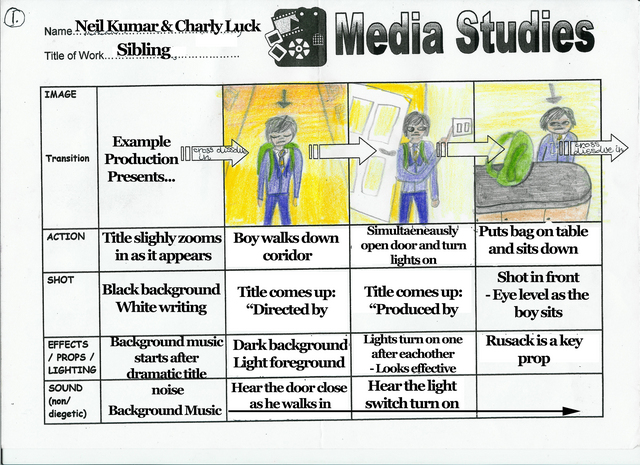
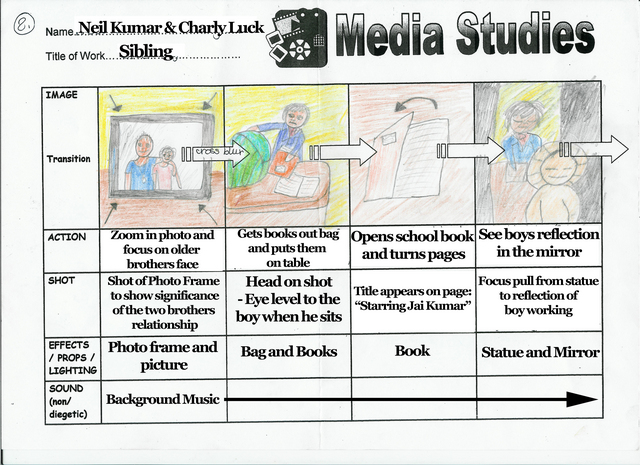
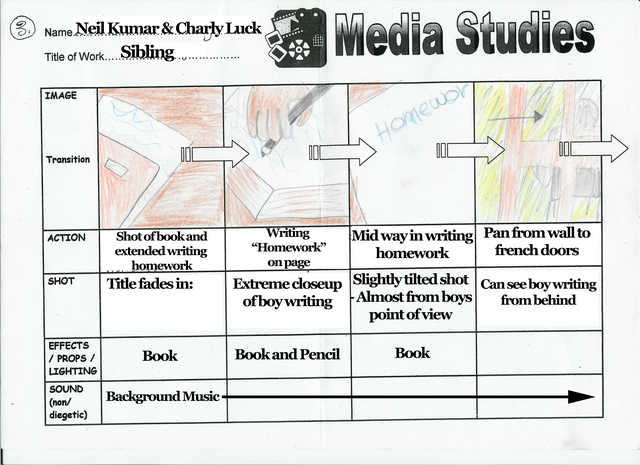
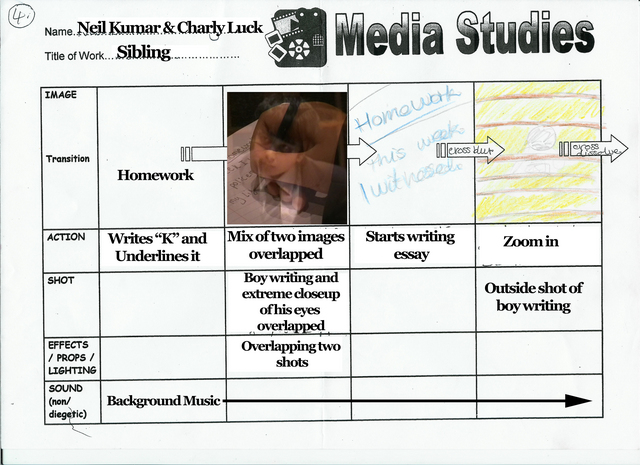
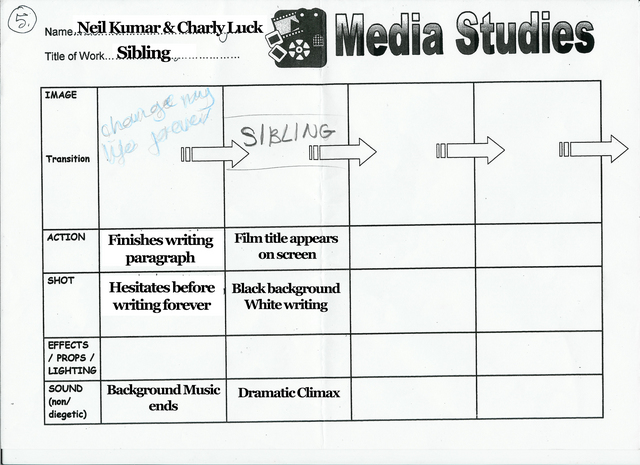
Opening Sequence - This is set after those events have taken place as the younger brother arrives home from school a week later and is given an extended writing homework assignment to write about events occurring in the last week and how they have affected him, as he witnessed his brothers death, that week had affected him deeply and would probably be remembered forever.
Main Plot (After opening sequence) - After the opening sequence, the audience would eventually find out what it is that the younger brother witnessed because as a result the he grows up with a hatred for authority, especially police force, turning to crime and revolution.
Plot (Before opening sequence) - A boy witnesses his older brother getting shot and being killed by a police officer in the crossfire of a shoot out between a criminal and a police force.
Opening Sequence - This is set after those events have taken place as the younger brother arrives home from school a week later and is given an extended writing homework assignment to write about events occurring in the last week and how they have affected him, as he witnessed his brothers death, that week had affected him deeply and would probably be remembered forever.
Main Plot (After opening sequence) - After the opening sequence, the audience would eventually find out what it is that the younger brother witnessed because as a result the he grows up with a hatred for authority, especially police force, turning to crime and revolution.
NEW Planning of Locations and Why Chosen
We knew that we wanted our opening to be filmed inside because its almost essential to the plot and we would eliminate lighting difficulties that we had encountered in previous experiences. Our two main options to use for the set our of project were:
- At School - In a Classroom
- A House - At a Table/Study
- Showing the boy in school uniform at home meant that we could still capture the schoolboy character in a scene were he is meant to be relaxed but in reality he is shown to be distressed and depressed rather than relaxed. This way we can express a contrast which is an element that I have noticed in many thriller films.
- There is a corridor, table and enough room in my house to correspond to the shots that we have included in the storyboard
- We have more control over the lighting as there are light switches that control different areas of lighting on the ceiling meaning we can lighten or darken certain areas of the shot.
- It is easily accessible as both of us live in Hitchin, this was a big problem we had before as the filming took place in Codicote and buses only run at certain hours. Also, it was difficult getting everyone together to film to travel there.
Planning of Characters/Actors and Why Chosen

We wanted our thriller to be different from the usual, predictable films and therefore we knew that our characters had to reflect that. We wanted our main character to be psychologically complex coming from a harsh but believable background.
The opening scene is set when the character is still young and before he develops in to the main character later in the film. We wanted to capture the innocence and hit the audience with a dramatic start which really sets the scene and expresses how the character is feeling and how badly it has affected him.
We knew we needed a young male actor to star in our opening, we also knew that we needed him to be readily available on the dates that we were able to attend. As i had learnt from previous filming experience were we found it difficult to get the actors together as members of the group had claimed they had informed the chosen actors on the dates but finding out on the day that the actors were unavailable.
Me and my other group member decided that my younger brother would be a good person to play the part as he young and willing to do it. Also, he wouldn't have to travel to the destination as we were filming the opening at our house, this meant that he is readily available on most days. We used his school uniform, school bag and school books, this added "mundane realism" to our film as the clothes and props were actually used in real life in the same situation in which our character would of.
Brainstorm of Ideas for the Title
For the film title we wanted a simple, but effective word that people can pronounce. We particularly liked the titles "Memento", "Vertigo" and "Se7en". This was when we decided that we wanted our title just to be one word(not include the word "the") and related to family or relationship.
After much consideration we got down to three titles:
"Retribution"
"Sibling"
"The Reprisal"
We decided to gain feedback from our target audience, which our class was a part of. We did a quick test using a focus group of only a few people on our table, this can be seen in the poll in the top right hand corner.

After much consideration we got down to three titles:
"Retribution"
"Sibling"
"The Reprisal"
We decided to gain feedback from our target audience, which our class was a part of. We did a quick test using a focus group of only a few people on our table, this can be seen in the poll in the top right hand corner.

The general favourite was the title "Sibling" as it fits in well with the plot and it is a simple word that is still effective.
To test this feedback we carried out a survey of around 30 people, they were given a tally chart where they could choose which one they liked best. We used people from our media class and another media class to gain this feedback as they would be the majority of our target audience.
We plotted our results in Microsoft Exel and converted them in to a pie chart that could easily be interpreted: The green portion represents the title "Sibling", the red "The Reprisal" and the blue "Retribution".
As you can see Sibling was the most favored choice and so we decided to stick with this title. After analysing the options we also decided to have the title in capitals such as: "SIBLING" this gives it more of a dramatic effect.
To test this feedback we carried out a survey of around 30 people, they were given a tally chart where they could choose which one they liked best. We used people from our media class and another media class to gain this feedback as they would be the majority of our target audience.
We plotted our results in Microsoft Exel and converted them in to a pie chart that could easily be interpreted:
 The green portion represents the title "Sibling", the red "The Reprisal" and the blue "Retribution".
As you can see Sibling was the most favored choice and so we decided to stick with this title. After analysing the options we also decided to have the title in capitals such as: "SIBLING" this gives it more of a dramatic effect.
Monday, 25 January 2010
Directors from the Genre - Martin Scorsese
Martin C. Scorsese (born November 17, 1942), the founder of the World Cinema Foundation, is an American film director, screenwriter, producer, actor and film historian. He grew up during the Vietnam War and did not serve as he struggled with asthma throughout childhood. This is said to have an influence on one if not more of his films, including the darkly comic "The Big Shave" in 1967, which is a negative representation of this war, suggested by it's alternative title "Viet '67".
Even from the early days, a "Scorsese Style" was becoming evident; New York Italian American street life, rapid editing and a eclectic rock soundtrack. During the 1970s he befriended many influential people in the film industry, Francis Ford Coppola, Brian De Palma, George Lucas, Steven Spielberg and was introduced to Robert De Niro.
Scorsese had many director trade marks that he used throughout his films. These include begining the film was segments from the middle or the end. He frequently used slow motion or freeze frames - this is were the image on screen stops and becomes a still picture. His lead characters were often sociopathic or wanted to be accepted by society and the lead women characters are normally shown as "angelic" through the eyes of the protaganist. He also used MOS sequences to put over popular music or a voice over, usually involving rapid camera movement.
Even from the early days, a "Scorsese Style" was becoming evident; New York Italian American street life, rapid editing and a eclectic rock soundtrack. During the 1970s he befriended many influential people in the film industry, Francis Ford Coppola, Brian De Palma, George Lucas, Steven Spielberg and was introduced to Robert De Niro.
Scorsese had many director trade marks that he used throughout his films. These include begining the film was segments from the middle or the end. He frequently used slow motion or freeze frames - this is were the image on screen stops and becomes a still picture. His lead characters were often sociopathic or wanted to be accepted by society and the lead women characters are normally shown as "angelic" through the eyes of the protaganist. He also used MOS sequences to put over popular music or a voice over, usually involving rapid camera movement.
Monday, 18 January 2010
Directors from the Genre - Alfred Hitchcock
Sir Alfred Joesph Hitchcock (13 August 1899 – 29 April 1980) was a English filmmaker and producer who created many suspense techniques in the psychological and thriller genres. He created over 50 films in six decades, mostly being silent films.
He seemed to enjoy the technical challenges of film making, for example in the film Lifeboat he staged the entire action of the movie in a small boat and yet managed to keep the production from benig monotonous.
Hitcock has a strong visual mind and would visualize the picture right down to the final cuts, he would then write this out in great detail in the script and then doesn't need to refer to the script when filming as he already knows it off by heart. He also said that when you've finished the script the film is perfect but in filming you loose at least 40% of the original concept.
While he did do a great deal of preparation, he did understand that the actual film making process often deviated from even the best laid plans and that his films wern't free from the normal hassles that production faces.
Alfred Hitchcock did not tolerate the "method approach" this is where the actors try to create themselves in to the thoughts and emotions of the characters, this helps them produce a "lifelike" performance, Hitchcock said that the actors should only concentrate on their performances and leave the script and character to the directors. He believed that the method actor was ok in theatres because they have free space to move around but when it comes to cutting the face of the actor and using shots of what they see, there has to be some discipline.
Hitchcock frequently used a technique called a "McGuffin" this is a device or plot element that catches the viewer's attention or drives the plot, it is something the whole plot is built around but has no real relevance to the story. For example the "All Spark" in Transformers, it could of been anything but it is the device that drives the storyline.
Towards the end of his life he worked on a the script for a spy thriller film, even though he had done some preliminary work, the movie was never filmed this was due to his own failing health. Alfred Hitchcock died from kidney failure in his home in California at the age of 80.
He seemed to enjoy the technical challenges of film making, for example in the film Lifeboat he staged the entire action of the movie in a small boat and yet managed to keep the production from benig monotonous.
Hitcock has a strong visual mind and would visualize the picture right down to the final cuts, he would then write this out in great detail in the script and then doesn't need to refer to the script when filming as he already knows it off by heart. He also said that when you've finished the script the film is perfect but in filming you loose at least 40% of the original concept.
While he did do a great deal of preparation, he did understand that the actual film making process often deviated from even the best laid plans and that his films wern't free from the normal hassles that production faces.
Alfred Hitchcock did not tolerate the "method approach" this is where the actors try to create themselves in to the thoughts and emotions of the characters, this helps them produce a "lifelike" performance, Hitchcock said that the actors should only concentrate on their performances and leave the script and character to the directors. He believed that the method actor was ok in theatres because they have free space to move around but when it comes to cutting the face of the actor and using shots of what they see, there has to be some discipline.
Hitchcock frequently used a technique called a "McGuffin" this is a device or plot element that catches the viewer's attention or drives the plot, it is something the whole plot is built around but has no real relevance to the story. For example the "All Spark" in Transformers, it could of been anything but it is the device that drives the storyline.
Towards the end of his life he worked on a the script for a spy thriller film, even though he had done some preliminary work, the movie was never filmed this was due to his own failing health. Alfred Hitchcock died from kidney failure in his home in California at the age of 80.
Sunday, 17 January 2010
The Killing Room
The films title is very bold "The Killing Room" suggests a room in which killing takes place, which is basically what happens but not as simple as mindless slaughter, the plot is quite complex and so I think the title should be as witty as the storyline.
The first few scenes are built up of rapid shots, these shots act as a "catchup" to enlighten the audience on all the events that have taken place up until this point, which is the point where the films starts and the main plot begins. A sense of enigma is created why are they locked in a room? what is the meaning of the strange questions they have been asked?
The immaculately clean, plain white walls of the room and the metallic tables and chairs that are bolted to the floor give a sense of some sort of experiment that seems ethically wrong, it gives the stereotype of evil scientists in white coats and face masks on. The quick shots in the main plot give a sense of urgency, this engages the viewer and helps that feel the affects of the characters situation. Actions such as the breaking of a pencil which is small, but significant because it also emphasises the characters emotions.
The dark, shadowy atmosphere in this thriller is contrasted significantly with the bright white, sinister room. The people watching down on to the "experiment" room are in a dark room above with black tinted windows which only looks out one way. This gives the effects that that the dark and evil people are watching down on the innocent people.
The mood is established with the shots of the metal chairs and bolted tables, this gives the sense of no escape. Also, the sounds of foots coming from the heels of smart shoes - ones that a doctor would wear, add to the effect that they are being experimented on.
At some points in the film joyful or happy music is played and sometimes old fashioned lullaby music, this gives an eerie effect because it is out of context.
The first few scenes are built up of rapid shots, these shots act as a "catchup" to enlighten the audience on all the events that have taken place up until this point, which is the point where the films starts and the main plot begins. A sense of enigma is created why are they locked in a room? what is the meaning of the strange questions they have been asked?
The immaculately clean, plain white walls of the room and the metallic tables and chairs that are bolted to the floor give a sense of some sort of experiment that seems ethically wrong, it gives the stereotype of evil scientists in white coats and face masks on. The quick shots in the main plot give a sense of urgency, this engages the viewer and helps that feel the affects of the characters situation. Actions such as the breaking of a pencil which is small, but significant because it also emphasises the characters emotions.
The dark, shadowy atmosphere in this thriller is contrasted significantly with the bright white, sinister room. The people watching down on to the "experiment" room are in a dark room above with black tinted windows which only looks out one way. This gives the effects that that the dark and evil people are watching down on the innocent people.
The mood is established with the shots of the metal chairs and bolted tables, this gives the sense of no escape. Also, the sounds of foots coming from the heels of smart shoes - ones that a doctor would wear, add to the effect that they are being experimented on.
At some points in the film joyful or happy music is played and sometimes old fashioned lullaby music, this gives an eerie effect because it is out of context.
Friday, 15 January 2010
The Dark Knight Analysis
The Dark Knight has many contrasts through out the film, the main overlaying contrast is the one between good and evil. Another contrast which occurs frequently to build up to the action is the simultaneous meetings of the good and bad characters in different scenes. This allows us to see the plot from both perspectives whilst also showing a vivid contrast between characters. A sense of enigma is built up in the beginning parts of the film when the new villain takes form as the "Joker". The film also creates enigma by showing the audience continuous events which seem unrelated to each other which cleverly come together at the end to form the climax.
This film, as evidence is given in the title, is pretty dark, holds a shadowy atmosphere throughout. Most scenes being shot at night. A few more contrasts throughout the film are placed such as the villains meeting in the dark and the heroes in the light, this shows that they have nothing to hide and clearly establishes the characters. There is also a contrast personality in the main hero himself, when he is in "batman" form he acts dark and shadowy, but when he is "bruce" he is bright and cheery. This may be to make sure the other characters in the plot can distinguish the difference and recognize that Bruce could not be Batman because of their vivid contrasting personality's. This reflects the contrasting views that the other characters hold about batman and about bruce, some think what batman does is wrong and some think he is a hero and some think bruce is a spoilt, "rich boy" whilst others think he is generous as he gives to charity and holds fundraisers for other people.
Although in the majority of the film there is a contrast between the villains only appearing at night and the good guys in the day, towards the end quarter of the film the darkness (the villains) start appearing in the day and then people who were safe in the day are no longer and so the atmosphere changes and everything seems bad.
The mood in the beginning is fast paced, it slows down in the middle until the end when the events start to form together in the climax. The atmosphere is kept consistently as everyone is addressing the same problem and looking for a solution to their current situation.
The music in the film is quite cold and eerie throughout and they build suspension with ticking noises, smashing and guns reloading.
This film, as evidence is given in the title, is pretty dark, holds a shadowy atmosphere throughout. Most scenes being shot at night. A few more contrasts throughout the film are placed such as the villains meeting in the dark and the heroes in the light, this shows that they have nothing to hide and clearly establishes the characters. There is also a contrast personality in the main hero himself, when he is in "batman" form he acts dark and shadowy, but when he is "bruce" he is bright and cheery. This may be to make sure the other characters in the plot can distinguish the difference and recognize that Bruce could not be Batman because of their vivid contrasting personality's. This reflects the contrasting views that the other characters hold about batman and about bruce, some think what batman does is wrong and some think he is a hero and some think bruce is a spoilt, "rich boy" whilst others think he is generous as he gives to charity and holds fundraisers for other people.
Although in the majority of the film there is a contrast between the villains only appearing at night and the good guys in the day, towards the end quarter of the film the darkness (the villains) start appearing in the day and then people who were safe in the day are no longer and so the atmosphere changes and everything seems bad.
The mood in the beginning is fast paced, it slows down in the middle until the end when the events start to form together in the climax. The atmosphere is kept consistently as everyone is addressing the same problem and looking for a solution to their current situation.
The music in the film is quite cold and eerie throughout and they build suspension with ticking noises, smashing and guns reloading.
Se7en Film Analysis
This film starts off slow and builds up a strong sense of enigma, raising many questions. what are the killers motives? and why did they choose to implement the seven sins?
In scenes of fear, apprehension or doubt, they use extreme props. For example old, moldy food or a dead boy surrounded by food and excrement. Also, the characters sudden movements and speech make the audience jump. Throughout most of the film when the "killer" is featured the audience never get to actually see his face until near the end, the focus is usually on the weapon. This creates a sense of suspense, fear and curiosity(keeping the audience attached to the plot).
The film establishes a dark, shadowy atmosphere by using dark rooms being set on dull days, also t he rain is very heavy in some scenes. Especially on the crime scene shots, this sets a contrast between the "real world" and the crime scene.
It keeps up a certain atmosphere throughout, their are some American stereotypes involved in the film such as the stereotypical smooth detective and the American cops calling each other by their second name. They use small features of the film like the sudden ringing of the phone to amplify the effect of suspense. They use focus split and pull quite often, this forces us to focus our attention on to specific details involved with the investigation.
The film also amplifies simple noises, and has the sound of noise from the traffic in the background. This allows scenes that are contrasting the investigation scenes to provide an atmosphere of the real world. They often use suspense music and tense music in action scenes to reflect how the character is feeling.
In scenes of fear, apprehension or doubt, they use extreme props. For example old, moldy food or a dead boy surrounded by food and excrement. Also, the characters sudden movements and speech make the audience jump. Throughout most of the film when the "killer" is featured the audience never get to actually see his face until near the end, the focus is usually on the weapon. This creates a sense of suspense, fear and curiosity(keeping the audience attached to the plot).
The film establishes a dark, shadowy atmosphere by using dark rooms being set on dull days, also t he rain is very heavy in some scenes. Especially on the crime scene shots, this sets a contrast between the "real world" and the crime scene.
It keeps up a certain atmosphere throughout, their are some American stereotypes involved in the film such as the stereotypical smooth detective and the American cops calling each other by their second name. They use small features of the film like the sudden ringing of the phone to amplify the effect of suspense. They use focus split and pull quite often, this forces us to focus our attention on to specific details involved with the investigation.
The film also amplifies simple noises, and has the sound of noise from the traffic in the background. This allows scenes that are contrasting the investigation scenes to provide an atmosphere of the real world. They often use suspense music and tense music in action scenes to reflect how the character is feeling.
Subscribe to:
Comments (Atom)